Products & Tables
This page covers the [product] and [table] sections of pppx.ini and the files PPPx writes. For where to download the inputs, see Data Sources.
Products
Section titled “Products”The [product] section selects a satellite-product source and the file paths.
[product]src = precise ; opt: brdc/precisenav = ./products/BRDC00IGS_R_-YEAR--DOY-0000_01D_MN.rnx ; broadcast ephemeris (brdc)sp3 = ./products/COD0MGXFIN_20221000000_01D_05M_ORB.SP3 ; precise orbit (precise)clk = ./products/COD0MGXFIN_20221000000_01D_30S_CLK.CLK ; precise clock (precise)erp = ./products/COD0MGXFIN_20221000000_03D_12H_ERP.ERP ; earth rotation parameters (precise)obx = ./products/COD0MGXFIN_20221000000_01D_15M_ATT.OBX ; satellite attitude (precise)bia = ./products/COD0MGXFIN_20221000000_01D_01D_OSB.BIA ; satellite bias (precise)ion = ./products/codg-DOY-0.-YR-i ; global ionospheric map (common)vmf = ./products/VMFG_-YEAR--DOY- ; VMF1 grid (common)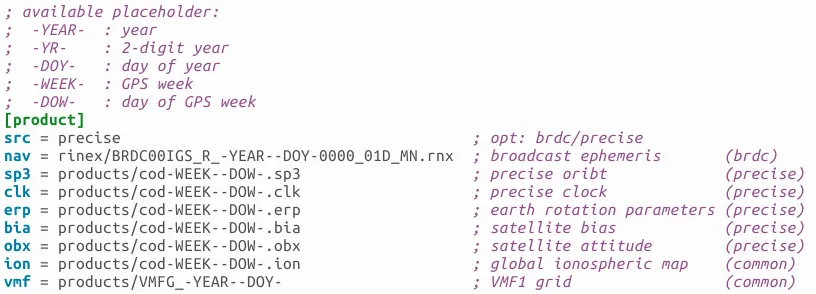
Source: brdc vs precise
Section titled “Source: brdc vs precise”brdc— orbits and clocks come from the broadcast ephemeris (nav). Theprecise-only products are ignored.precise— orbits and clocks come from IGS products.sp3is required; the others are optional. Ifclkis missing, clocks are taken from the SP3. Usingpreciserequires theigsatxtable.
Per-product notes
Section titled “Per-product notes”- Only
sp3is mandatory forprecise; broadcast ephemeris also works for PPP. ionis required when[model] ionouses a GIM (IONEX/brdc), andvmfis required when[model] trop = VMF1.- Precise orbits/clocks can be used for SPP, but the DCB is not handled for single-frequency SPP — use
[model] iono = IFin that case. - For PPP: a
biaproduct is needed whenppp_ar = yes; nominal attitude is used ifobxis missing; pole-tide corrections are skipped iferpis missing (fine for most applications).
Date placeholders
Section titled “Date placeholders”Product paths may contain placeholders that PPPx fills from [session] date (or the first RINEX epoch), which makes multi-day processing easy:
| Placeholder | Meaning |
|---|---|
-YEAR- | 4-digit year |
-YR- | 2-digit year |
-DOY- | day of year |
-WEEK- | GPS week |
-DOW- | day of GPS week |
Table files
Section titled “Table files”The [table] section points at the static model files PPPx needs.
[table]igsatx = ../../table/igs14.atxoceanload = ../../table/oceanloadchannel = ../../table/glonass_chngpt2w = ../../table/gpt2_1wA.grdorography = ../../table/orography_ell
| Table | Purpose | Required when |
|---|---|---|
channel | GLONASS frequency-channel numbers | GLONASS carrier phase is used (ppp/rtk/tdp) |
gpt2w | GPT2w tropospheric coefficients | [model] trop = GPT2w |
igsatx | IGS ANTEX satellite/receiver antenna models | [product] src = precise (PCO always; PCV for PPP/RTK) |
oceanload | Ocean-tide loading coefficients per station | optional (skipped if missing for the station) |
orography | Ellipsoidal heights for VMF1 grid points | [model] trop = VMF1 |
It is good practice to set all table paths so a change of model never trips over a missing file. See Data Sources for how to obtain oceanload and igsatx.
Output files
Section titled “Output files”A run produces up to three files, all sharing the observation file’s base name.
| File | Contents |
|---|---|
.pos | Per-epoch receiver position, GPS clock, and ZTD estimates. |
.log | Debug log: cycle slips, outliers, residuals, ambiguity resolution. |
.stat | RTKLIB-format residuals/estimates for visualization. |
pos file
Section titled “pos file”The primary output: one record per processed epoch with the station coordinates (ECEF, metres), their standard deviations, the receiver clock error (GPS), and the zenith total delay (ZTD). The coordinate frame follows the orbit products used.

log file
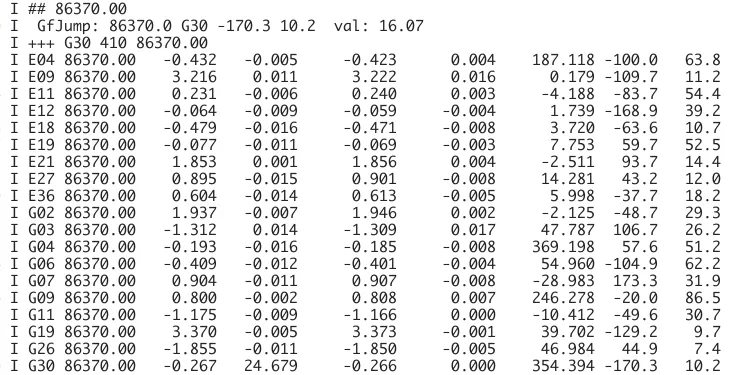
Section titled “log file”Written whenever [output] level is not off. It records cycle-slip and outlier detection plus a priori and post-fit residuals. Each message is tagged with a severity level:
| Tag | Level |
|---|---|
T | Trace |
D | Debug |
I | Information |
W | Warning |
E | Error |
C | Critical |
stat file
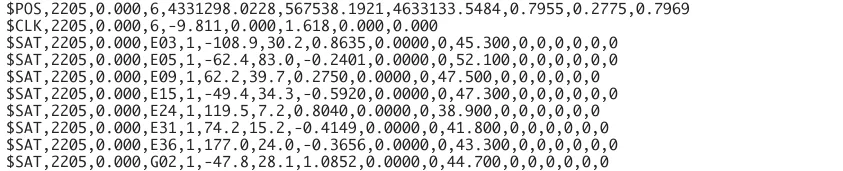
Section titled “stat file”Always generated, in RTKLIB’s stat format, for visualization. PPPx writes the $POS, $CLK, and $SAT records. Unlike RTKLIB, $CLK values are in metres (not nanoseconds) and are absolute clock errors per GNSS system rather than inter-system biases.
See Visualization for plotting these files.